Showing posts with label Travelogues. Show all posts

Wednesday, January 14, 2026

Silk Road Travelogue

Link to Photo Album #1

This trip happened because you could fly to Tashkent from Kuala Lumpur for cheap, starting late 2025. It was about 3/4 solo and 1/4 day tours. By default, an intrepid traveller would come here to plow the Silk Road and hit Khiva, Bukhara, Samarkand, and Tashkent (in this order or the reverse). However, I went for variety, because these two countries have something in them for everyone

  • Modern city with abundant amenities, cute metro stations, Korean food, some Silk Road stuff: Tashkent
  • Nature + ski / hiking: Amirsoy, Chimgan, Shing Valley
  • Silk Road stuff: Samarkand, (Bukhara and Khiva)
  • Aral Sea ecological disaster-tourism, the second largest art collection in the former Soviet Union, fashion shopping: Nukus

The most useful languages to learn here are Uzbek, Tajik and Russian (as lingua franca). People in Nukus, Karakalpakstan speak Karakalpak, and people living around Chimgan speak Kazakh. A sizeable Korean community gathers at Sacred Heart Tashkent on Sunday evenings. When the usher found out that my Korean was dogwater, she switched to Mandarin for my benefit. These plus English makes 8 languages in total encountered on this trip

Part 1: Cities

Tashkent

TASHKENT: Cushy city I would describe as a mix between Paris and Seoul. You can tap into any bus and metro station with a credit card. I had thought Magic City was a tourist trap until I visited and realised it was really an Uzbek trap. Uzbekistan Ovozi Street is nice and leafy and posh. There are little corners around town where you can hide in and pretend you are in Korea; The restaurant "Makkeoli" served one of the best makkeoli that I have ever tasted

Nukus

NUKUS: Town at the edge of the desert in the Khwarezmian delta reminded me of Lincoln, Nebraska because the buildings were short, streets are in a nice grid and the airport is within walking distance to everywhere. I was here to see the famous art museum and buy clothes at Inddi Fry (they take online orders, so I probably didn't have to go in person, but I did anyway for the sheer hell of it)

Part 2: Mountains

Link to Photo Album #2

Chimgan

Here was where I first tried riding a horse unassisted. It started when I spied a posse of tourists on horseback riding to the mountain. Among them was a lady in a beige trenchcoat, the sort that every fancy urbane woman in Tashkent has on during the Autumn, but she steered her steed with ease, as if she had spent all her life on the steppe; her hair was blown about by the stiff breeze; she had the likeness of Siranush Harutyunyan; I was so awestruck that I found the next rider that came along and asked for a ride on his horse. The rider's name is Isobek, a Kazakh, and his horse is called Vasily. After some time messing about, Isobek gave me a crash course on horse controls and let me loose. I had been on many guided horseback tours where the horses were strung along by the guide and never got to steer the horse myself, so I thank this duo here for pushing me one step up!

Seven Lakes (Haftkul, Shing Valley)

Seven lakes lie along the Shing River. They are pretty as heck and are visited daily by daytrippers from Samarkand across the border. The village of Padrud was one of our stops. They are blessed with electricity 12 whole hours per day. The roads are perilously paved over scree and should be attempted only by donkeys or the pluckiest drivers

Part 3: Silk Road

Link to Photo Album #3

The Heavenly Horses

This was the 4th Century BCE. Alexander the Great had a fit and tore through Asia building cities named "Alexandria" instead of going to therapy like a normal person. On the ruins of Cyropolis he built Alexandria Eschate, the "Furthest Alexandria" (modern Khujand). The garrison installed here would grow into a network of Hellenic city states in the Ferghana Valley. These were known to the Han as Dayuan 大宛, meaning "Great Ionia"

It is now 104 BCE, in the reign of Han Wudi. The Great Ionians had developed a reputation for breeding the Heavenly Horses: absolute units, sturdier and hardier than any variety known either to the Chinese or to their frenemies to the north, the Xiongnu. (They allegedly also sweat blood out of their pores, but I have no idea what to do witu this information)

Emperor Wudi, who craved violence* and anticipated war with Xiongnu in the near future, sent an envoy to Alexandria Eschate asking to buy some sweet sweet Heavenly Horse. The court of Alexandria Eschate convened.

One said, "It's been nice doing business with the Han, but the Heavenly Horses are our only edge over everyone else. Should we really let them have it?" Another scoffed, "Let's not entertain these weaklings. They are too far away! Even if they send an army here, the Taklamakan Desert will claim them before they reach us"

So they roughed up the delegation, robbed them of all their treausres, and replied: "Come And Take Them"**

Naturally Emperor Wudi went apesh1t and sent forth General Li Guangli who slapped together a comically large army of riffraff and they crossed the Taklamakan Desert and ransacked the cities of Great Ionia and replaced the king of Alexandria Eschate with a new king and grabbed 3000 Heavenly Horses and went back to China through the Taklamakan Desert again, in the process losing 20,000 out of 30,000 men and also 2000 of the looted horses.

Reference: Book of the Later Han 《后汉书》; artistic license

*Note 1: "Wudi 武帝" is a posthumous regnal name; the character 武 was chosen to reflect the fact that this emperor habitually craved violence

**Note 2: Whether any Spartan individual was involved in the conversation is left to the reader's imagination

Clans of Zhaowu

The Sogdians had become overlords of the Central Asian Silk Road by the 8th Century CE. In the Chinese Annals (e.g. in the Books of Tang) they were known by their Chinese clan names (tied to the places of their origin) and collectively as the Nine Clans of Zhaowu 昭武九姓. Sogdians enjoyed a high level of prestige in Tang society and were often made governors of the northwestern commanderies. Unfortunately, the most famous Sogdian individual in Chinese history was An Lushan. He was very bad news (c.f. An Lushan Rebellion)

The Sogdian identity lives on today in the region of Sughd, the language of the Yaghnobi, the nation of Tajikistan, and every business in Samarkand who puts "Sogdiana" in their name for style points

Friday, May 10, 2019

The Canada Post


I was stuck in Canada (a.k.a. Canuckland) for a month, from mid-March to mid-April, on the whims of the Embassy of the United States (a.k.a Yankland), who needed that much time to unearth my life story and slog through the related paperwork. This month has hit me with very varied experiences and I think I was very glad to have had the opportunity for a one-month forced exile from the Greatest Country on Earth. I have no overarching narrative to present here. Instead, I shall lazily present a series of extremely short stories, as has been the norm for my recent travelogues, and invite the reader to make whatever conclusion they want. Here we go.

1. How to be stranded in Canada for a month


I applied for a J1 visa to the United States. I brought all the things that they said I must bring to the interview. Ms. Consular Officer Lady, who I am sure is a great person to her family and friends, asked me for my CV, which I did not have on my person. So she drew up a writ of refusal, asked me to send in my CV and research history, and told me to wait for "two to four weeks" and "you can go anywhere, just not the United States". And then the interview ended.

The plan had been to stay less than a week at the time. No one likes to see the word "refusal" in such a situation either. I remembered the weather became extra slushy those few days.

Thomas the Burundian was my host. He was a good guy and tried to reassure me that things were not so bad, after all. "We had a guy from India in here; he was in the same situation as you are now. They asked him to stay put for a few months, and in the end he went home to India to wait it out. (You know what, never mind.)"

2. Thomas of Burundi

Wurtemburg House
Thomas the Burundian works at Amnesty International. Thomas the Burundian is an exquisite gentleman. Thomas the exquisite gentleman lives in an apartment in a grand old house at Rue Wurtemburg, and gets guests to stay in the extra rooms through Airbnb. Thomas greets his guests with a welcoming wave, wafting gratuitous amounts of civility. On the first night of my stay we shared the dinner table and talked about geopolitics. I found that we disagreed on some things. I decided not to bring up the hilarious story of Pierre Nkurunziza, who wanted to be President-for-life like Paul Kagame from the country next doors, but could not, and instead had people rising up against him in huge riots. So the story goes.

Less than a week into my stay, Jessie Liu of Nepean returned to Canada from a trip to sunny California and arrived at Wurtemburg by car. She yanked me right out from there and let me stay at her son's room for the remainder of the exile. For this, I owe her my eternal gratitude.

3. Auntie Liu of Nepean

Chinatown of Ottawa
Auntie Liu is the daughter of a friend of my father from his days of mucking around in the United States in his youth. Auntie Liu works for the Canadian government, like most people in Nepean. She has formed many ideas about the governance of Canada and suchlike and have been more than enthusiastic to make sure I (and anyone else within earshot) knew about them. I found that we disagreed on some things, but never mind. It is a good thing to be listening to people who disagreed with you.

Auntie Liu introduced me to Costco and the Asian Supermarket T&T 大统华, also punnily known as 炸药店 (Explosives Store). She taught me how to cook steak, how to distrust Chinese restaurants with their scammy card reader machines, how to pick out fresh produce at Explosives Store, how to deal with the public transportation, how to pick a good high school for your kids in Ottawa, how to go to Chinatown, and many other potentially useful life skills.

I tried as much as I can to be good, clean up after myself, and do some cooking. The neighborhood of Centrepointe, where we were at, had a nice church in a half-hour's walking distance, making it handy for daily mass.

4. Parkhill University Residences

At the oratory
Matthew of Surabaya attends the University of Ottawa (uOttawa), and had to find a place to stay. It was late, and school housing had run out. Searching for alternatives on the internet, he found Parkhill.

Parkhill University Residences sits at a quiet spot in back-alley downtown next to the Embassy of Mali. An oratory in the building and resident Frs. Paul Cormier and Joseph Escribano make daily mass extra handy here. Not all are practicing Catholics: Matthew, for his part, stayed for the cozy environment conducive for study rather than for the religious formation, and Minh is an outright communist who had found his way into Parkhill by sheer dumb luck.

Like the city itself, Parkhill has English and French speakers in equal measures, making conversations interesting.

Weekly meetings and prayers make for excellent bro-company with many illustrious gentlemen around town. Also on one occasion I was invited to become a museum exhibit for a full room of high school-age fellas who asked me questions like "Is Singapore part of China" just to see how I would react. But the happenings at Parkhill are too many to pen here.

5. The Church in Ottawa

St. Clement's - FSSP Latin Mass Parish
St. John the Apostle - Parish near Auntie Liu's house
St. John the Apostle serves the elderly of Centrepointe, offering mass on Tuesdays to Fridays at 9 o'clock in the morning. Father Lindsay takes a vacation on Mondays, so on Mondays I join for noonday mass at the Notre Dame Basilica at Downtown, near to the National Gallery. On Saturdays I join Latin mass at St. Clements, which sometimes is filled to the brim with French-speaking children. Later, I would discover that the same parish runs a nearby school.

Notre Dame - Cathedral
Our Lady of the Annunciation - Anglican Ordinariate Parish
The Ordinariate parish is run by Fr Doug. Fr Doug helped me through the liturgy because I was the only guy who showed up and had to do the responses without any prior experience. I learned that the Ordinariate Mass is almost identical to the Tridentine mass of the Latin tradition. I have a newfound respect for Ordinariate Catholics and their compatriots, the High Church Anglicans.

The Eastern Catholics are represented by the Syro-Malabars and Ukrainians, but the locations of their parishes are weird, and I never had an excuse to visit them. The Chinese parish is in Orléans, a Francophone neighborhood, which is also very odd.

6. The Church in Gatineau

Notre-Dame-de-l'Île - Parish of Hull District, Gatineau
My experience of the Church in Gatineau has been disappointing. To be fair, I had been warned about the state of the church in Quebec, which seems to be in terminal decline since the 1960s. The website of the Cathedral did not show the correct mass timings. Notre-Dame-de-l'Île's actual mass timings also differed from what was shown on the sign up front. By and by I found a group of aunties in a meeting at the church's basement. "Pas de messes ici! Shoo! Shoo!" they said to me. "No mass here! Go away!"

- Vous devez changer votre site-web!
- C'est pas notre problème!

Five minutes before mass was due to start, the priest arrived in his car and assured me that the mass and Eucharistic Adoration was, contrary to the women of the basement, set to take place that evening. I was overjoyed. I called him Monsieur because he did not have his collar on. He would disappear again shortly after the start of Adoration, leaving a layman to say the priest's lines and elevate the Host.

6a. Exchange with Suzanne from Quebec City on the Quiet Revolution

This came from the Catholic History Geeks Facebook group. I found it interesting and relevant, so I repost it here.

Me: [...]It surprised me to see that the church in Ottawa is thriving but the parishes in Gatineau (which is supposedly Francophone and Catholic) feel gutted. I read that the parish of Notre-Dame-de-l'île in Hull was formed out of four former parishes when the churchgoing population fell from a quarter of a million to ten thousand. It is way harder to find daily masses there than right across the river. Friends from Québec, or who are familiar with Québec history, is this the result of the so-called "Quiet Revolution"? Have you lived through this period of Canadian history? What was it like?

Suzanne: Hi there. I grew up in Quebec. People describe the "Quiet Revolution" as this hardcore anti-Catholic period. I don't remember it that way. It was more of a progressive indifference of the Church that today has developed into full-blown anti-religion. Quebeckers never had to fight for their faith. They were never constantly attacked by Evangelicals or other Protestants; so they were never forced to learn the why and wherefore of their faith in order to defend it. So Quebec's faith was a mile wide and an inch deep, depending a *lot* on sociological transmission to keep the faith going. This is why when there was an onslaught of secular thinking after the advent of T.V., Quebeckers' faith couldn't take it. The Church, faithful Catholics, have very little confidence in themselves or their faith. They basically retreat in the face of the onslaught. And that's why you have churches closing down and Quebec losing its Christian landscape.

7. The geography of La Capitale

Link
The Capital of Canada sits on the south bank of the Ottawa river, which drains east into Saint Lawrence. The river forms part of the border between the provinces of Ontario (south) and Quebec (north). The big village of Gatineau sits on the north bank, within walking distance, and enjoys the perks of being close to the national capital without technically being part of it.

The neighbourhoods of Ottawa work roughly like this, from west to east: Kanata has the high-tech startups. Bayshore has gunfights with guns smuggled in from Yankland. Nepean has retirees and government workers. South Keys has the airport. Downtown, Vanier and surrounding areas have drug addicts and Prime Minister Justin Trudeau, who is also a drug addict. In the furthest east, Orléans is the French-speaking district, as mentioned.

Downtown Ottawa is split in two by the Rideau Canal, which functions as a skating rink in the winter (i.e. most of the year). Parliament Hill and Ottawa's most iconic buildings sit at the left bank of the canal, within eyeshot of the Embassy of the United States on the right bank. Unlike many other cities, Downtown is densely built, human-sized, walkable, and well-connected by public transport. For this reason it swiftly became my favourite place on the continent.

This building is important for some reason
8. Canadian Soft Power

Auntie Liu's sister has a husband, a genial fellow named Try. Try is Cambodian-Canadian, a Francophone, and lives in Gatineau. He visited us at Nepean one fine evening, bringing gifts from the wife's place in Nanjing. A thing of Try which made an impression on me was that he spoke in a mesmerizing drawl which I have come to associate with the country of Canada. It was late into my stay in the country, and it had grown on me as well.

The country has had me in its thrall for a long time, its influence on me disproportionate to its influence as a world power. I would happily watch a mediocre Canadian movie over a similar American film of higher acclaim. I had learned my first French words from Quebecker songs. I had eschewed authentic American country music, preferring its imitators on the Manitoban prairies. It was no different for this trip. I had my fill of Canadian movies and Canadian literature. The film adaptation of Joseph Boyden's Through Black Spruce aired at Bytowne Cinema during the time of my stay. I bought and am reading Boyden's earlier novel, Three Day Road, which had catapulted him into fame. The Haida-language film Edge of the Knife aired in Toronto in the last week of my stay, and I took this excuse to go on a road trip down south.

It helped very much that Ottawa bookkeepers sell very good books at very affordable rates at many places about town, spoiling me rotten.

From Patrick McGahern's bookstore, which is probably more expensive than most others
9. The almost-road trip to the North

I was briefly tempted to make a trip to Iqaluit during this time. The airfare (~2500 CAD) felt prohibitive, and the temperatures in the Canadian Arctic in the month of March (minus a gasdfjillion degrees in any scale) seemed to be beyond the reach of my human experience. Strangely, the former did more to discourage me than the latter.

The temptations would continue, and, as someone who becomes irrationally excited at the sight of Inuktitut syllabics, I accepted them as a test and opportunity for mortification in this blessed season of Lent. Confiteor tibi, Domine. Mea culpa, mea maxima culpa.


Don't look at it, Andy
*throws away magazine*
10. A quiet way of living

Despite all appearances and temptations, I was not keen for adventure. People who know me all know that I am a homebody who likes to play Civilization VI too much for my own good. I was anxious to get into the rhythm of work in Cleveland more than anything, to the beat of a quiet, uneventful mode of living. This was no time for adventure!

I complained to Mom, and she gave me a dress-down, saying something along the lines of: Suck it up. There's nothing you can do about this mess. You are now on holiday, whether you wanted to or not. Go out and learn to have some fun.

That's fair. I went to the museums and grudgingly assumed the role of a tourist. They turned out to be great. The National Gallery is now a favourite place.

Yay, art!
History!
Tame cockroaches!
But when I was not in the mood to spend on earthly pleasures, I found home in the public libraries, one branch in Downtown on the Rideau, and the other at the former Nepean City Hall. Here admission and wifi are free, and there was shelter and quiet. I could print my readings, write my papers, and get the research work going at snail's pace (I was told not to bring my laptop).

At the Downtown branch of Ottawa Public Libraries, I discovered that the homeless population shared my passion for books, internet access, and free shelter from the elements. This made for quite interesting company whenever I wound up studying here. The librarians of Downtown graciously adapt to serve their customer demographic, and treat everyone cordially and with respect. There is just one awkward detail: when you needed to use the bathroom, you have to ask the front desk for the keys.

11. Good people

There is a hidden Chinese restaurant on the south side of Rue Rideau, between Dalhousie and Walter. They occupy the husk of a former restaurant, giving themselves no distinguishing brand or name, and never bothering to lift a finger to change out the signage or the furnishings. However, I must point out that their noodles are very satisfying to horf. The restaurant has become very popular among the uOttawa students who manage to find them. I must also note that they are unique in the neighbourhood for rounding down (not up!) the price for cash payments to the nearest dollar, and for not accepting tips!


Byward Market has a Moroccan restaurant named Le Casablanca. I went there whenever I felt posh or wanted to have coffee that was not watered down. I built some rapport with the family running the place over time. Near the end of my stay, the building had a fire which gutted one of the other restaurants. No one was hurt, but it was probably really bad for business. I hope they are all doing better now.


I should remember that people are good and can be good all on their own, whether they are good to me or not.

The last random story I would like to write about is about an old man and his two young granddaughters, whom he brings to Centrepointe Avenue to be picked up by the school bus every weekday morning. I spotted them often on my way to church and drew a sketch of them, from memory, because I found the scene to be exceptionally adorable. I'll let the picture do the talking.


Are they twins? The girls were of similar heights. Their jackets and pants were colour-coded, but the hats are switched. Grandpa holds both their backpacks. I have no surefire way to know who owns which bag now. Where will they be when I come to Ottawa again? Maybe, the sisters will be all grown up when the time comes. Will they still think of themselves as the pink and green halves of a pair then? Maybe something else?

I've written enough; it's time to sleep.

Thursday, January 03, 2019

That Ten-Hour Hard-Seat Joyride from Beijing West Station to Jining, Inner Mongolia

Datong station, August 2018
I remembered that ten-hour hard-seat joyride from Beijing West Station 北京西站 to Jining 集宁, Inner Mongolia because of this article which was about mean people who hogged seats which didn't belong to them on a train somewhere in China.

It was a little different on the ten-hour hard-seat joyride from Beijing West Station to Jining, Inner Mongolia, because when it started, there was not enough seats for everyone. I had a ticket in hand which had my seat number on it, and I assumed it was same for the others, too. Even so, many people had to be content to stand in the aisle. How this works is still a mystery to me.

Jining is not very far away from the capital, just about 500 kilometers. Train-wise, this translates to eight hours, because although rail between major cities in the country have largely become high-speed links, the region of Ulanqab ᠤᠯᠠᠭᠠᠨᠴᠠᠪ remains for now a forgotten backwater country brimming with clean air, friendly bogans, barbarians on horseback, and a crap ton of nothing. No high-speed rail just yet for this place! Seats on Chinese trains came in four grades: soft bed, hard bed, soft seat, and hard seat. The last one has the sole advantage of being cheap as dirt. It was also the only one available because I booked my seat too late. I say this in my defense! No one in their right mind puts themselves through this ordeal willingly.

Before the train left the civilized world, I had some time to text Mom: my train is now sprinting towards the open steppes, at snail's pace! I spoke too soon! Very soon the train came to Yanqing District 延庆区, a mountainous area which (I learned later) was prone to landslides. Rail operators here become tetchy over the mildest drizzle and would grind the train to a halt whenever it began to look a little wet. The PA system put it this way: we are stopping the train because of heavy rain. What rain? I looked out to see slightly damp trees swaying gently on verdant slopes. Meanwhile, the eight-hour ride morphed into a ten-hour ride before our very impatient eyes.

I must mention here that the rail service hires peddlers to sell anything from packed lunch, stationery, cheap toys to spectacles and medicine to the passengers. These people are overjoyed about the delay and wasted no time making the biggest profit they could out of our misery, raucously announcing their goods up and down the aisle. You have no idea about the amount of useless crap people would buy when they have been jammed in together in hard seats and needed something to distract themselves with. I bought a novelty smartphone holder this way; I bought two, actually, but they weren't very good. 

Milk candy for the lactose tolerant, USB cables for phone addicts, reading glasses for old people — and, of course, who can forget the local produce? To the refugees from Beijing's apocalyptic hellscape, Mongolia must have seemed God's own country, flowing with milk and honey! We grow blueberries here, announced one, rattling off a list of health benefits of the fruit which erupt from the soil of the unspoiled steppes with the most bombastic wholesomeness. You! She pointed at me — I was wearing my Dad's Xiamen University 厦门大学 shirt that trip, accidentally marking myself as a hapless southerner — Betcha don't get that good shit in Fujian! And so this show played out all ten hours, while the train swung first by Kalgan 张家口, then by Datong 大同, then finally to Jining, where my friend Peter and his parents were waiting.

An eight-hour train ride is terrible, but a ten-hour train ride is something that will forge undying friendship between complete strangers. I offered my seat to a random dude in the aisle, feeling slightly guilty of keeping the seat all to myself. This he accepted until a short while later when he offered it back to me again, and I would sit for another half-hour, etc. Eventually, we both agreed that the hard seat sucked, and that we would very much prefer just standing in the aisle together. He tried to start a rapport with me by asking for some light reading, but demurred when I said it was a Taiwanese book, written with traditional characters. 

A lady was bringing her daughter to see her grandma in Jining. The girl was cute and smol and hyperactive, in other words a huge headache for her mother, who wailed: come back! What's wrong with you? They'll kidnap you and you'll never see me again, you little devil! as she ran up and down the length of the cabin. I laughed and rooted for the kid inwardly, because she is meant to be as free as a bird, and this metal tube is no place for her. Gosh, I hope they are doing well now.

I think I'll always remember this Ten-Hour Hard-Seat Joyride from Beijing West Station to Jining, Inner Mongolia. This shall go down as an unexpectedly awesome decision that I would never make again. All you future pilgrims and tourists, best be flying in next time!

Wednesday, September 27, 2017

Extremely Short Stories from Tehran

People have voiced some doubts about me accepting a work trip here, but I told myself that if a country has given the rest of the world Laleh Pourkarim, Marjane Satrapi and Mehdi Sadaghdar, then it can't be that bad at all. So let's go for it

Laleh the Swede, Marjane the cartoon character, and Mehdi the madman who starts fires for giggles
"Why have you come to Iran for just four days?" wailed Fr. Paul Lawlor, when I went to see him at St. Abraham's Church, Tehran. "You only have time for Tehran; there's nothing to see here!" I must agree that the material and natural treasures of Persia is something that is immense and not even easily covered in two weeks, but a leave quota is a leave quota and, all things considered, Iran has given me more than I had hoped to handle in just four days. So here is a rough summary of the trip, given in my habitual format of extremely short stories.

16 September: The Visa Lady

After disembarking, the first person I met in Tehran was the Visa Lady. The people at Imam Khomeini Airport had thought it suitable to plant this petite lady in front of the visa office as the coordinator, because the said lady also happened to be a thunderous sasspot who threw thrice her weight and made her presence known constantly. Walling herself into a perimeter with tape barriers, the Visa Lady was able to deal with the tourists, one by one, without any hint of being ruffled whatsoever. "You! Go to the insurance counter. You! Go and line up at the bank terminal. You! Go sit in the corner and wait!". There must have been a hundred of us, with just one Visa Lady! Occasionally she gave visa inquiries a pause and let loose a strident announcement: "Where is my pen? Somebody has taken my pen -- Give me back my pen!" Her voice sliced through the air like a scimitar, jerking awake a few tourists who were beginning to doze off in their seats, and the pen was always returned sheepishly to its rightful owner. Just the one lady, and her one pen!

17 September: The Two Mareks

The two Mareks are father and son. The son is a hardened traveller who is addicteed to biking and has arrived at Tehran after a few months cycling on the road from the Czech Republic through Romania and Turkey into Iran, and the father tags along (after much persuasion from his son Marek) for good fatherly company. We had breakfast together. Breakfast was splendid because of koloocheh, flat buns infused with cardamom and fillings of brown sugar. The other highlight is feta, which, to the great surprise and confusion of Masoud, are made from cow's milk in this country.

17 September: Masoud, the Kurdish Guy who runs the Hostel

Masoud comes from Bookan, in far west of Iran, where he grew up speaking Kurdish. He learned Farsi only after he started his undergraduate studies. His Persian friends could never believe it whenever he told them that part of his history. What a shame -- If only we spent the morning singing Xoş e Hewreman together and left the other guests no peace to eat their breakfast! He wished me luck with the presentation as I checked out to visit the Chaldeans, and I left too soon.


17 September: The Chaldeans

Click for slideshow
St. Joseph's Cathedral lies halfway between the metro stations Ferdowsi and Taleghani, and I walked there on foot after a ridiculously sumptious breakfast. Half an hour before mass, Archbishop Ramzi Garmou and five other people were chanting the rosary at the foremost pews. This went on for a while and I was scared that these were all the people that could be had in mass. Thankfully, more people joined over the hour to fill the pews, so that by communion time there were about fifty of us in the church, including the two bishops and deacons at the sanctuary. It was a Chaldean liturgy, all in Aramaic (their native as well as liturgical language), and very traditional. The women wore veils, I mean headscarves, well alright -- that was what they had to wear in the streets anyway. Communion was given in both species. The half-English liturgy sheet I had procured from the Detroit Chaldeans was helpful, even though not followed to the letter. I did not understand the homily in Aramaic, so I used the time to doodle the Archbishop of Tehran in my notebook, and then the High Altar.

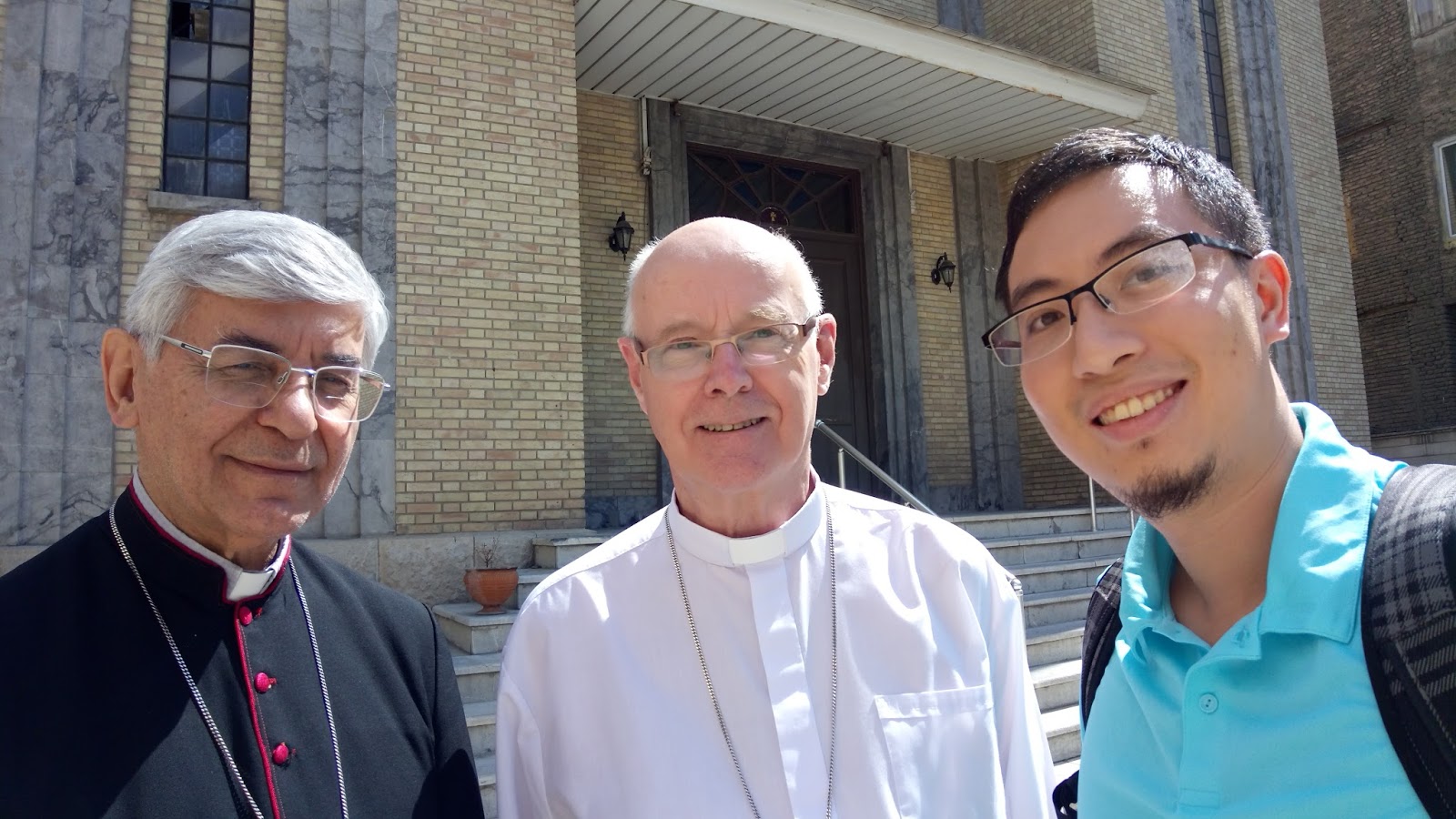
Archbishop Ramzi of Tehran, Bishop Jean-Paul of Calatia, and whoever it is who is on their right; has anyone seen that dude before? No one?
Later, during lunchtime, Archbishop Ramzi Garmou said to me that the Chaldean community was native to Iraq, himself being born in Zakho, in the far north of the country. The young Youssef, seated across me, is a seminarian and was at Tel Keppe five months ago where he went to the liberated churches that had been torn up by Daesh. Bishop Jean-Paul Gobel is visiting and is seated at the head of the table as the guest of honour. A local priest who spoke only Aramaic was seated to my right, and to my left two religious sisters (whose names I struggle to recall) who spoke Italian with one another and a mix of French and English with me, using a whichever works approach. The multilingual conversation in that fine and wild lunch spanned topics from Madam Halimah Yaacob to Patriarch Louis Sako, from the Kurdish Independence Referendum to Imam Khomeini Getting A Primary School Named After Himself Again, and from Food Safety Standards in China and to Who's Winning the World Cup. In addition they seemed very interested in Singapore, and loved the picture of my Archbishop incensing Our Lady of Fatima.

The Chaldeans had icons for sale on the shelf. I had been tasked my my mother to buy them home. However, the uncle here said to me that the only guy who has the keys to the cupboard was away at Hamedan for a few days. Drat! It seems I will have to come back to Iran another day to get them.

Gift for the Chaldean community from my parish (need more gifts ugh)

17 September: Mahdi, the Carpet Guy of Tajrish


Mahdi studies Chemistry at the University of Tehran. At night he helps out at his father's carpet store, where one day he came and said "ni-hao" to me and made friends and sold me a carpet so I have something to bring back to my mother. His carpets are made of sheep wool or silk, with different weaving techniques involved. The shop has inexplicable received name-cards from diplomats and other dignitaries for some reason (did these people all have an urgent need for a carpet whenever they stop by Tajrish?). Mahdi wanted to sell two, but I bought one and left and got lost in the market and wound up at the mosque that he liked to pray in. How splendid to have your workplace and your worshipping place right next to each other! I shall enjoy Holy Cross as long as I still can.

18 September: The Watering Holes

Nobonyad Metro Station
Guy who sold me tickets to the metro was hard of thinking. Guy who sold me insurance at the airport lacked his left hand. No, that did not stop them coming out and working and greeting customers like any old fellow. I had trouble with the currency, and just let whoever was there do the math for me. 15,200 Rials... or was it Tomans? I couldn't hear the prices clearly, and the lady at the roadside restaurant laughed at me, took some of the notes from my hand, then handed me the change. Sometimes the change came in coins. Coins are so rare in this country! Termeh from Yazd sewed intricate doilies; a lady and her mother brings them to the metro at Azadi square and sells them. People sold things even on the trains and no one was there to stop them. My instincts were to ignore them, as if they were fraudulent operations, but the couple next to me took a sample insole and bought a few pairs after discussing it intently between themselves. I bought a toothbrush this way! Toys, stationery, lemon juicers, sports bags came to you in rush hour and you bought them all if you were just about to fall asleep and didn't pay attention. Even little toy guns that rattled; you could buy them in case you got bored on the plane and wanted to amuse yourself. Some bored punk came and shot my face twice with one of these annoying trinkets. The day was hot and the metro stations came equipped with what I thought of as Watering Holes, each one a big sink with water fountain taps, and us strangers huddled around for a sip. Tehran water was drinkable everywhere, and it was sweet, like how Singapore water used to be.

18 September: Walking on Streets


Walking the length of Andrazgoo Boulevard was not the most pleasant thing to do on a Sunday evening. The next day I walked to Nobonyad Square, where the roads were narrower, houses were castles and the vegetation lush and manicured. The Ambassador of Venezuela has a place to hide here, where the angry mob has not yet been able to reach. I learned that crossing the road anywhere takes you a roughly 50-50 mix of false confidence and total trust in the goodwill of strangers.

18 September: Saint Abraham's Church


PSA: In case some of you are Jesus freak like me and also happen to want to go to Iran at some point in spring or summer, I have on hand the full mass schedule covering the city; yell for it in the comments! You can choose from mass timings for liturgy in the English, French, Italian, Korean, Assyrian, or Armenian languages. Said schedule has been passed to me by the kind Fr. Paul Lawlor despite his hellishly packed schedule as the only priest of St. Abraham's Church.

St. Abraham's Church sits delightfully close to the metro station at Enghelab Square, and strangely attracts a sizeable following of Persians. Christians, or Muslims who are just visiting? It was hard to tell. The website boast many fruits borne in the community: translations of hymns and prayers to Persian, ecumenical dialogue with Shi'a leaders, artwork, masses, and receiving visiting Dominican fathers from all over the world. That and the Instagram location-based post aggregator of St. Abraham's Church would tell the story much more eloquently than I could ever do, so I leave you with them.

18 September: The Selfie Man of Azadi Square


Gilsie has introduced to me the existence of this hilarious monument. For all the hype surrounding its famed firewall, Iran has not be able to halt the scourge of the selfie.

A similar statue was unveiled the other day at Amasya in Turkey. Vandals stole his phone, so he needs a bodyguard now.

18 September: Niavaran


Niavaran was the Shah's old stomping grounds. Nicolae Ceaucescu was his buddy. His children loved looney tunes, and his wife hoarded modern artwork and pagan idols. Such used to be life in Niavaran.

The Polish scientists said that Niavaran reminded them of the palaces of Communist Poland, the sort one could still find standing in Warsaw.

19 and 20 September: Conference

Yikes! Someone caught me doing my first oral presentation ever
During lunch at the IPM Campus, Majid, Mohsen and gang pressed me into their lunchtime clique and fed me "doogh" just to see what my face looked like afterwards. They were a boisterous group whose impeccable manners and generosity sometimes betrays a primordial mischieviousness. Majid Esmaelzadeh is a Turkish guy (my guess is that it means "Azerbaijani") from Urmia who likes watching Korean drama and making jabs at Farsi speakers. Mohsen Farokhnezhad is from Mashhad and always says "excuse me" if he goes through a narrow doorway first. Salar Abbasi comes from Yazd and laughs a lot, no matter what the joke is. Majid led the group to his hideout in the back garden, where a wooden shack has been built for PhD students seeking refuge from the stresses of work. Curiously, a whiteboard has been installed inside the shack, adorned perennially with equations and diagrams.

"Doogh" turned out to be yoghurt mixed with salty water. The particular version served at lunch came with a touch of mint. Still, it's not everyone's kind of stuff, even if you were from Iran. Majid laughed at me as I chugged the drink and said that it would make me sleep like a log all afternoon. So I nodded back in agreement, and nodded off to sleep for the next two lectures.

16 to 20 September: Tiger Balm

Coming to a place where gift-giving is so much a part of the social fabric, I figured that I might as well participate.

This habit actually started with Chinese tourists in the middle east, particularly Egypt. Despite being made infamous for all kinds of bombastic shenanigans, they have also been welcomed in Egypt for bringing along handy and fun-sized capsules of ointment to give away.
Hey! We make Tiger Balm Oil here in Singapore. We're famous for that stuff!

[source]
In a fit of patriotic fervour, I bought a trove of the ointment to give away to taxi drivers and shopkeepers, etc., just anyone I could ever come across. My opinion is that it is a pretty good fit for them: Just as Tiger Balm is used by workers who can surströmming in the smelliest factories of the world, so can it soothe the senses of many a smog-choked Tehrani, or allay the anxieties of the taxi drivers who must make a living in the city's terrifying traffic conditions. I think it's worth trying if you're going there! Giving is its own reward.

The ride back to the airport took two hours. Who would have thought the airport could be located so far away from town? The uncle who drove me looked like he could use Tiger Balm very much. He got to have my remaining two jars, and my short trip to Tehran concludes here. Good bye for now.

Wednesday, July 12, 2017

Martin of the Field of Pines

I arrived in Europe again once too often, this time for an academic workshop and then a short road trip around the Iberian peninsula. This is a very hasty overview of our story. We were at Cantabria, Portugal and then Sierra de Gredos and were very happy, collecting many memories and stories. I record them here so that we can have a look at them on gloomy days.


The trip was long and varied and is best organised into three parts, each one dedicated to an appearance made by our Heaven-Mom at the three different corners of Spain and Portugal where we went to. Each part has its own share of short and sweet stories which do not necessarily weave into a huge overarching narrative, and I keep them as such.

I. Garabandal
Madrid, Santander, Zurita, Las Presillas, and San Sebastián de Garabandal

The Adventures of Mom at Garabandal: It is said that Our Lady of Carmen appeared to four young girls at Garabandal several times from 1961 to 1965. The girls were so excited to see her that they spent their time with their necks constantly craned to the heavens, even while walking around, running up and down the hill behind the village, etc. The villagers passed to them things which needed Mom's blessing, and were happy. A certain Father Luis Marie Andreu also had a glimpse of Our Lady of Carmen, then died of happiness during the night. Today, the story has been kept alive by her devotees, especially the media-savvy religious siblings of Hogar de la Madre who made us go to Garabandal after we visited them.

San Sebastian de Garabandal from the hilltop

The story of Michael the Brazilian: Michael the Brazilian took a lift in our car to reach Garabandal. He had been walking uphill from Cosío, roughly 3 kilometers away. He came to the village once upon a time and then decided to stay there for 5 years. He could not understand my Portuguese.

The story of Zurita: Hogar de la Madre, or Home of the Mother, was started by a mystic they call Mamie and a priest called Fr. Felix, if my memory serves me well. Publishing and painting became the forte of these people. A cluster of printing presses were donated to them, and they have used it to print magazines for subscribers everywhere, as far as I can tell.

Mass happened here
We learned that an icon is not so much painted out by the artist, but prayed out.


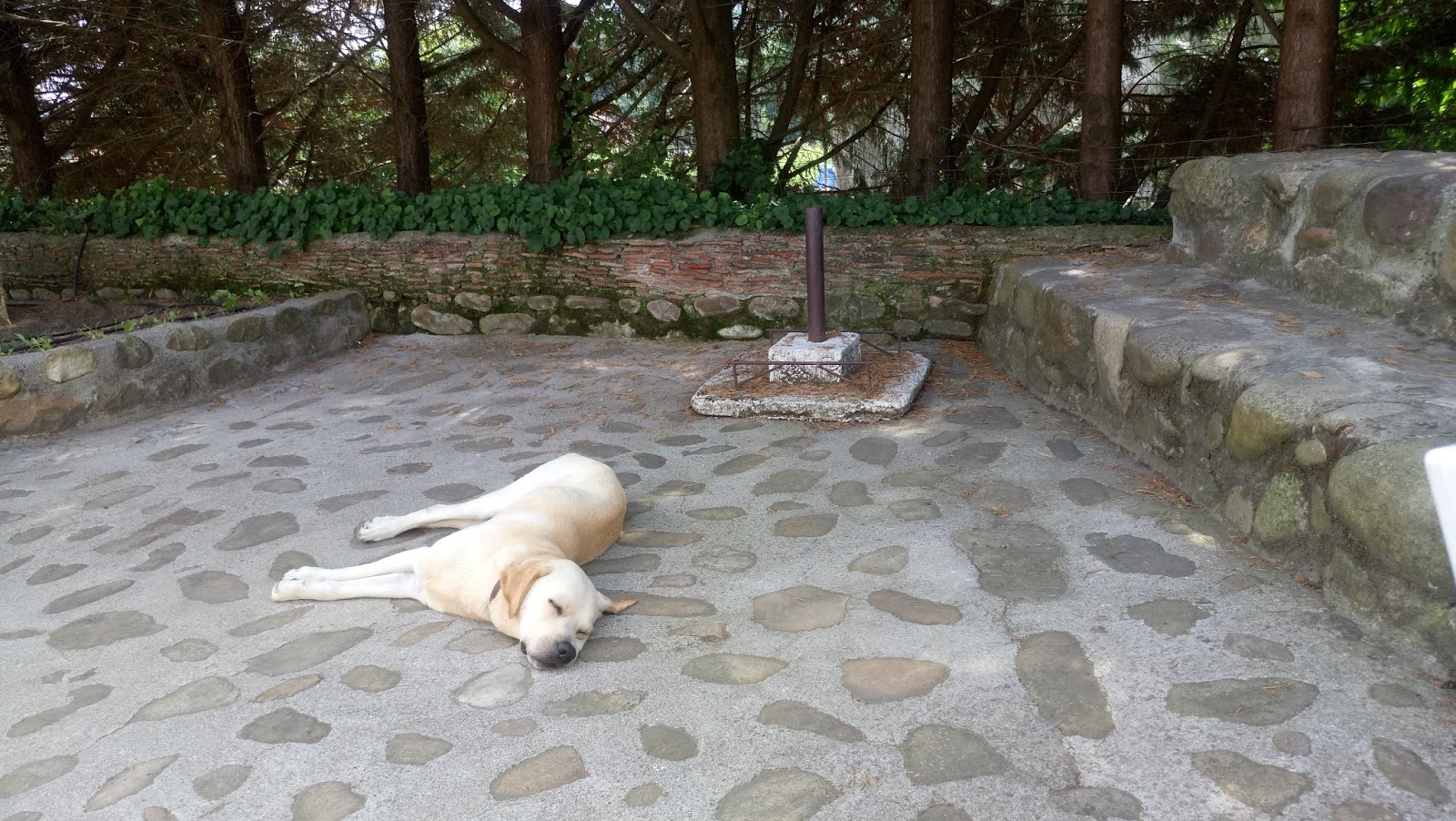
The sisters keep two dogs as rat predators. The sprightly one they call Andalo, in honour of Andalusia a.k.a. the Real Spain. The name of the lazy one I could not remember, but the name meant "Rug". The brothers kept a cat.


How to reach Garabandal by car: The best way to reach Garabandal by car from Santander is to turn into the Río Nansa valley road from A-8 at Pesués. This was the route pointed out to us by the sisters at Hogar de la Madre. The route suggested by the navigation system, on the other hand, took us through a very annoying journey with mountain roads. 

How the landscape in Spain changes during long drives, Part 1: Cantabria, also known as Green Spain, is very green and very picturesquely slopey. A tunnel or viaduct is encountered here every few minutes or so. As you go south, the mountains taper off gradually and then one is confronted with a vast arid plain in the provinces of Palencia and Valladolid which stretches all the way up to Salamanca. After Salamanca, as one approaches the Portuguese border at the town of Fuentes de Oñoro, it becomes (if I remember correctly) a rolling terrain where trees (cork? holm oak?) are planted in neat ranks and files. By the time one has driven into Portugal, behold: There comes again a pleasant green rolling itself across the land again, like a milder, less menacing Cantabria.

Water prices: were higher in Madrid and Toledo than they were in the wetter parts of the country, as is expected. Wine is often cheaper. Food is expensive but is usually worth it. Usually.

II. Fátima
Salamanca, Fátima, Aljustrel, and Lisboa

The Adventures of Mom at Fátima: The story of Mom at Fátima is long and illustrious and readily available at more reputable sources than this one. Tom Hoopes of Aleteia wraps it up succintly, saying that 13 July 1917, the day of her apparitions, "was the day Our Lady scared the daylights out of three shepherd children by showing them hell and sternly warning them about a second global war and a new age of martyrdom." As it happened, WWII came and passed, the Soviet Union came and passed, and St. Pope John Paul II was shot at and almost killed (by a hairsbreadth) by a Turanist lunatic in 1981, all in fulfillment of her prophecies. The fanfare surrounding the town of Fátima this year is due to it being 2017, a neat hundred years after the first apparitions. Posters welcoming the Pope during his previous visit are still plastered around town, but the lull of pilgrims in late June is something to be appreciated.

The scaffold put up at Cova de Iria, with the Basilica belltower
The Rosary: I was used to a simple night rosary session with around 7 friends in a Google Hangouts chat. I mistakenly assumed that the same would happen at Fátima, a place which receives around 5 million pilgrims every day and is also responsible for a permanent new addition to the Rosary itself. It turned out to be a huge fanfare, five decades led in two languages each, followed by a procession where a statue was dragged out to circle the sanctuary complex with four bajillion people with crowd control, then concluded by the Salve Regina (I wasn't sure when it was going to end).

I usually didn't think it decorous to take pictures of Rosary sessions, but here you go. I took a picture. Here be candles galore.


The Knee Walk: Esther from the summer school had heard of Fátima. "They are crazy," she said. "They do that thing where they walk on their knees down a path." The knee walk here is something pilgrims do out of sorrow and penance for sin. I can now verify that it is very crazy indeed. The abrasions that I earned from the walk took days to heal. However, at least one very resourceful pilgrim has been spotted doing the walk with kneepads. This is something that potential pilgrims should take note.

A Day Mass Where We Spotted A Priest Who Resembled Fr. Ben Holdren of Nebraska So Much That I Just Can't believe how we keep on winding up in the same country. As I had mentioned in this blog here and here, Fr. Ben Holdren gave me doughnuts and heard my confessions during a very low point of my life. I still have not gotten over it. I must testify also to the healing power of doughnuts.

The girl got some candles after mass. They smell very nice. She lit them, placed them very carefully into the candle holders where they offer the candles, and offered a prayer for each one. At that time the fires were licking at the stands and melting the candles so that they bent over and rested on the next tier of candle holders, as if taking a seat. They burned so fiercely that I wondered if one should just throw the candles into there and run away as fast as they could.

I prayed also for the Sisters and Brothers of Hogar de la Madre, as promised.

The Adventures of Cow In The Oven: Clara and Sérgio Patrício run a good restaurant near the place we stayed. The name of the restaurant is Santa Rita, and they serve Portuguese food from the Azores. The food, especially the one named Vitela (or Cow In The Oven in the English menu), brings a tear to me eye.


I wrote a review on Google for them, as promised. This is how it goes:


The Adventures of the Lu (路) Family in Fátima: The Lus run the Restaurante Si Hai next to the Patrícios' restaurant, and keep it open way into the night. Mr and Mrs Lu had decided to travel to Fátima from Shandong to open a Chinese restaurant out of a acute sensitivity to business opportunities. They receive the many hungry pilgrims who come to Fátima from Malaysia and Indonesia on huge tour buses every day. A lady from Singapore arrives regularly to help with the cleaning-up, and other regular visitors come to lodge with them during high seasons. The couple are not believers, but a small icon of Mary watches the place day and night.

Their two children attend school in the town and are taught things in Portuguese. English language schools, much preferred by Chinese expats, are available in the capital, but it was not thought worth it to send them there.

The Adventure of the Tart Run: Tart run happened one day after the girl heard of the famous Pastéis de Belém and wanted to try their tarts. So off we went to Lisbon. Lisbon drivers were the worst. We walked to the famous Pastéis de Belém past the statue of a pompous dude stuck on a tall column surrounded by four marble wenches bathing in public view. A huge clamouring queue of people from all over the world can be seen at the entrance of the bakery (custard tartery?), but the purchase was over in 10 minutes or so. The custard tarts were nice and it was a happy day.

Gas prices: are much higher in Portugal than in Spain. I never figured out why this is the case.

III. Chilla
Candeleda, Mombeltrán, Navalsauz, Ávila, Oropesa, and Toledo


The Adventures of Mom at Chilla: It is said that the Virgin of Chilla appeared to a certain goatherd Finardo, who lived at Candeleda during the seventh century, and revived his dead goat. In gratitude, the Candeledans built a chapel where she appeared, and made her their patron ever since. Her icon can be seen plastered in every shop in Candeleda. The Candeledanos used to remember more about the Virgin of Chilla, but the written records had been thrown in a well during the war with France and were gone for good. Despite this setback, the devotion has continued unabated.

Why we ended up in Candeleda, and an explanation for the title of this entry: We had intended to lodge at the Sierra in the village of San Martín del Pimpollar before our stay, but I changed the booking because the villagers wanted to have some fun playing music to the wee hours in the morning for the two straight nights we were due to be staying there. The manager of the guesthouse of San Martín del Pimpollar, Juan Francisco Redondo Sánchez, was a good person and had tipped us off about it in advance.

The name Pimpollar translates literally to a place of pimpollos -- "pine-chickens", or saplings of pine. During one of our day trips, we managed to descend upon the hapless Pimpollarese (who were expecting anything but tourists on that quiet day) by visiting their parish church at Navalsauz, a sweet old edifice with a bell.

Ricardo and Toñi's Fabulous Guesthouse: Having been scared off the north slope of the Gredos, we took refuge on the south, at a place I chose because the website said it had air-conditioning. This is Casa Rural la Josa, a guesthouse of 6-ish rooms outside Candeleda along a one-lane dirt path up the mountain which is really fun to drive up in.


Ricardo de la Vega, a spunky septuagenarian, and Antonia "Toñi" Velasco Serrano, his wife, live here together and run the guesthouse and spoil their guests rotten with food and company. They share their space also with a family of five cats (3 of which are smol kittenz), and their children and grandchildren came to visit them on Saturday afternoon.

Smol kittenz were too smol to be seen
Dinners happened on a terrace where one could see the plains to the south, as far away as the Montes de Toledo. There was one evening when a column of smoke in the plains, and Ricardo called the fire department; he just so happens to be so uniquely situated that he could regularly spot and report fires raging in the neighbouring province. Toñi emerged from the house twice, once to say hi and once to say bye. She introduced herself in German for some reason.

One sees right into the Castilla-La Mancha bit of Spain, up to the Montes de Toledo
Afterwards, while driving along the Río Tiétar, I noticed scorched earth on the side of the road. Random fires seemed common in Castilla-La Mancha in the summer. We were lucky not to have run directly into one.

How the landscape in Spain changes during long drives, Part 2: Sierra de Gredos is a tolerable alpine climate this summer, meaning that it does not reach the temperatures of a blast furnace, as what has happened in lower-altitude cities in New Castille such as Madrid and Toledo. By driving down to Toledo one approaches the region of La Mancha, which is a strange and unforgiving habitat where green things have all but given up being alive. Not having ventured very far into that area, we failed to spot any windmills or Don Quixote, but nothing has indicated to us that such things might not be lurking somewhere just out of sight. Gas stations are harder to find here.

Cities and Towns around Candeleda: We drove up the mountain pass to Ávila. Along the way there were Mombeltrán and Puerto del Pico, at 1300 m. Mombeltrán had a castle which we could not go into, and Puerto del Pico had cowpats scattered across the cool alpine field. A memorial to the Fallen of Spain have been set up here. This spot seems to be a start point of a route that hikers take to Pico Almanzor, the highest point of the Sierra.

The Fallen of Spain (some letters missing)
The (same?) cows were spotted crossing the street in the afternoon as we approached Arenas de San Pedro, but we were not sure why they did so. They were escorted by some fine cowboys.


Ávila has a neat old wall. This is the first thing one learns of Ávila. The second thing that one learns of Ávila is that St. Theresa of Ávila came from Ávila. Her headquarters here has been very blinged-up, and it even came with a souvenir store managed by grumpy storekeepers.


Lunch was at a very well-reviewed Portuguese restaurant. They had cod also, but it wasn't Spiritual.

Walls are an ever-looming presence in this town, and so we pay a visit.


The first thing one learns of Toledo is that the ground here is paved with murder weapons.


The second thing one learns about Toledo is that the old Mozarabic rite masses are still performed here, a relic reminding us of how Christians here used to do things when the Umayyad Caliphs were in charge of the Iberian peninsula. Masses in Mozarabic rite happens only on Sunday mornings at the Cathedral.

The third thing that one learns about Toledo is that it is epic. It came with its own soundtrack which is played in a loop at Plaza del Salvador, and people who lived there had to listen to it all day. Cloth draped over the pedestrian streets kept it cool, and flashmob dancing happened left and right made sure that we were reminded and thoroughly convinced of the city's epicness.


Oropesa lies along the way to Toledo. They have there a nice view of the Sierra. The walls here are painted with intricate storylines by the local schoolchildren. The locals liked to visit the castle.


Candeleda is a place populated by the elderly, one of which told us that we were a cute couple. A river flows through the town. It is presently dried up in the absence of meltwater, but a trickle still passes by the round polished boulders. When one bends over one of the lagoons, they would be able to see fish lurking in them. What carefree creatures these must be! And at that moment the sun shone on us and kept us just the right degree of warm.


And my story ends here
this is as much as I am able to put to keyboard now
There is much more to say, if I recall them, but you might have to find me in person
for me to get started on the yarn. It's just in the nature of stories.
I'm tired. I have to go now.

Appendix I. Events
17-18 June: One extremely hot and stressful day in Madrid
18-24 June: IEEE Summer School 2017, Santander
25 June: Visit to the Sisters/Brothers of Hogar de la Madre at Zurita and Las Presillas, impromptu trip to San Sebastián de Garabandal for a rosary
26 June: Long car trip to Fátima via Salamanca
27 June: Epic Night Rosary at the Sanctuary complex
28 June: Tart Run (short crazy car ride into the capital)
29 June: Medium-length car trip to Casa Rural La Josa, a guesthouse outside of city boundaries of Candeleda, at the south slope of the Sierra below Pico Almanzor
30 June: Day trip to Ávila, passing by Mombeltrán, Puerto del Pico, and Navalsauz
1 July: Walking trip to Candeleda
2 July: Day trip to Oropesa and Toledo
3 July: Departure from Spain

Appendix II. Mass locations
Sunday 18 June: Almudena Cathedral
Sunday 25 June: Hogar de la Madre, Zurita
Wednesday 28 June: Sanctuary of Fátima
Sunday 2 July: Primate Cathedral of Saint Mary of Toledo